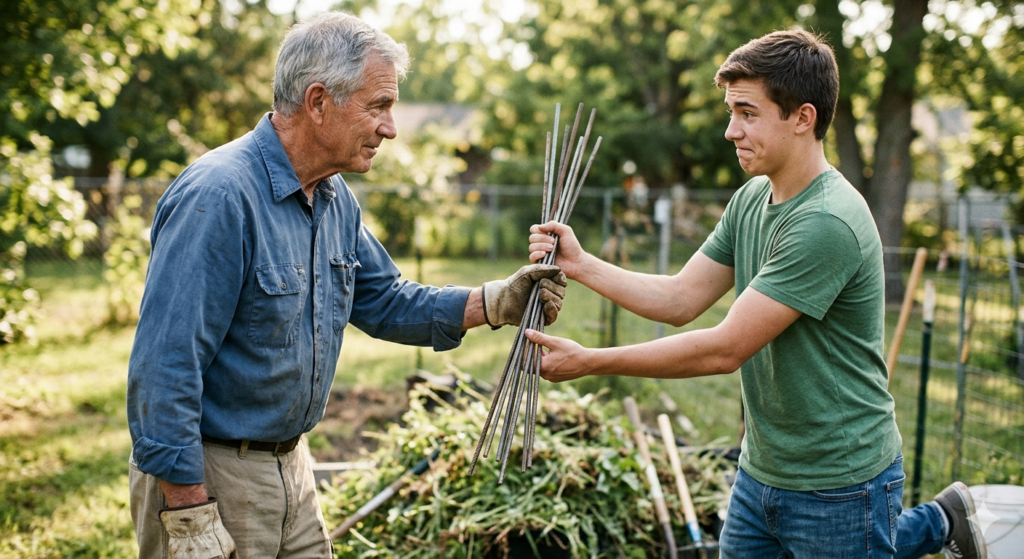
My daughter Hannah and one of her friends were helping me do some yard work one day. I didn’t know it at the time, but she had told her friend not to judge how much something weighs by how I pick it up as it will most likely be heavier than they expect it to be. While moving stuff around I grabbed a bunch of metal rods that I had with one hand and handed it to her friend. He grabbed it with two hands and nearly dropped it due to the weight. She reiterated to him, “I told you not to judge the weight by how he handles it.”
Although this may be a humorous story there is something important that we can learn from it. You see , this was not heavy and if I would have scolded him for not being able to carry it as I did, he probably would have been offended and stopped helping. Depending on the weight I could have harmed him by handing him something that was too heavy for him to carry.
Well how does this relate to us in everyday life? In life you will notice that some people are emotionally stronger than others. These people are not intimidated easily and are very strong-willed. You may call them a pillar of strength, resilient, or remarkably steadfast. They are characterized as having a high capacity to bounce back from adversity, acting as a “pillar” during crises and keeping steady under intense pressure. We all know these types of people and maybe you are one of these people.
The problem is when you are used to carrying heavy things as though they are not, you can unintentionally develop a lack of patience for someone who doesn’t. And when these people come to you for help you can harm them by assessing the weight of the situation by how you would carry it. Examples of this can be someone dealing with something that they can’t seem to get past and responding with “just get over it.” Or maybe they struggle giving up something that they need to give up and responding with “just quit.” For the strong person, these answers feel like solutions, while to the struggling person, they feel like sentences.
While to the strong person this seems like a logical answer it is a harmful answer to the one who can’t carry it. Not only does it not help them, but adds the extra weight of guilt of not being able to carry it. In turn they still have the struggle, but now they are carrying more and the strong person that they know has alienated them. They now will most likely not go to this strong person that they know and may carry this load longer than they should and potentially cause more harm to themselves.
How does this look? I was privy to a conversation of a young man years ago who was trying to accomplish something, but was struggling to. This was not a business venture , but a ministry that he was trying to start. A stronger gentleman that he knew thinking that he would motivate him by his challenge said, “well just quit then.” The young man said “okay” and he did. He walked away from this and never picked it back up. The stronger gentleman likely thought he was being helpful or motivating, which highlights the tragedy of a lack of empathy.
I will follow this with an encouraging story. I mentioned my daughter Hannah earlier. She told me a story once that she was helping someone move. She had carried a box outside to be loaded. The man of the house grabbed the box and he said he immediately was thinking, “Hannah carried this as if it wasn’t heavy, I’m impressed.” He said that he was able to move the box as it was not too heavy for him, but didn’t realize how strong that she was. Her response to him was, “I’m used to working with my Daddy.” Working with me and me giving her the things that she could carry while I carried the things that she couldn’t helped develop her strength.
Remember that when we encounter those struggling that we are presented with opportunities. You can help them and encourage them. Thus helping build their overall endurance and strength. Or you can put a barrier in between you and them so they avoid bringing you their burdens and then try to carry them without the help of someone that could help. Know that just because it isn’t heavy to you doesn’t mean it isn’t heavy to them. Know that how you respond can build a relationship of trust where they know that they can come to you.
Ultimately, our strength gives us a choice in how we handle the people around us: we can either coach and train them to become strong themselves, or we can respond in a way that causes them to sideline themselves. One builds the Kingdom; the other leaves people sitting on the bench. Let’s choose to be the kind of strength that invites others into the work, rather than pushing them away from it.
Galatians 6:2 ISV
Practice carrying each other’s burdens. In this way you will fulfill the law of the Messiah.