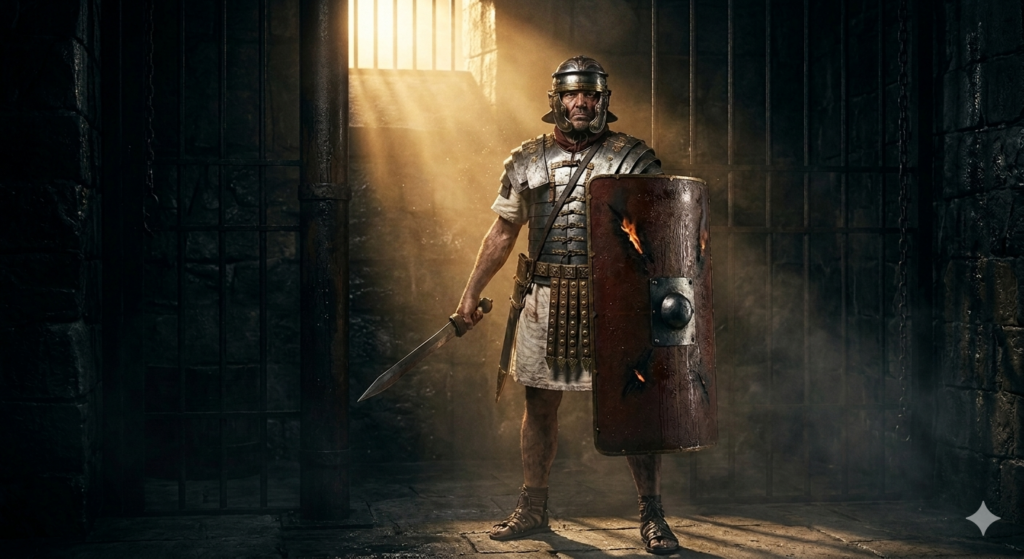
A lot can be learned from the Armor of God. The Apostle Paul wrote the Epistle to the Ephesians while imprisoned in Rome around 60–62 AD. During this time, he was under house arrest and chained to a Roman soldier. Day after day, Paul observed the soldier’s armor, weapons, and combat readiness. Under the inspiration of the Holy Ghost, he used that imagery to paint one of the most powerful pictures of spiritual warfare found in Scripture.
Ephesians 6:10-18 KJV
10 Finally, my brethren, be strong in the Lord, and in the power of his might.
11 Put on the whole armour of God, that ye may be able to stand against the wiles of the devil.
12 For we wrestle not against flesh and blood, but against principalities, against powers, against the rulers of the darkness of this world, against spiritual wickedness in high places.
13 Wherefore take unto you the whole armour of God, that ye may be able to withstand in the evil day, and having done all, to stand.
14 Stand therefore, having your loins girt about with truth, and having on the breastplate of righteousness;
15 And your feet shod with the preparation of the gospel of peace;
16 Above all, taking the shield of faith, wherewith ye shall be able to quench all the fiery darts of the wicked.
17 And take the helmet of salvation, and the sword of the Spirit, which is the word of God:
18 Praying always with all prayer and supplication in the Spirit, and watching thereunto with all perseverance and supplication for all saints;
Many teachings present the armor of God as primarily defensive, with the Sword of the Spirit being the only offensive weapon. However, a closer look at Roman warfare reveals something deeper: nearly every piece of armor was designed not merely to absorb attacks, but to advance, overpower, and break enemy resistance. Roman soldiers were not trained to retreat. They moved forward with coordinated aggression, and Paul intentionally used that imagery to describe the Christian life.
The Belt of Truth
The Roman soldier wore a belt called the balteus or cingulum. It secured the tunic tightly to the body and held the soldier’s sword in place. Without the belt, loose clothing could tangle the legs and cause a soldier to stumble during battle.
Spiritually, truth is what holds everything together. Truth stabilizes the believer. Without truth, everything else becomes loose and unstable. Truth is not merely intellectual agreement with doctrine; it is a life anchored in the reality of God’s Word.
The Breastplate of Righteousness
The Roman breastplate, known as the lorica segmentata, protected the vital organs, especially the heart and lungs, from fatal blows.
Righteousness guards the inner man. Through Christ, we are made right with God, and through obedience we walk in holiness. The enemy constantly attacks the heart with guilt, shame, condemnation, temptation, and accusation. Righteousness protects the believer from those deadly spiritual wounds.
The Shoes of the Gospel of Peace
Roman military sandals, called caligae, were fitted with sharp iron studs on the soles. These gave soldiers traction on unstable ground so they could stand firm and continue advancing in battle.
The Gospel of Peace gives the believer stability and confidence. Peace with God produces firmness in spiritual warfare. But these shoes were more than defensive footwear, they also became weapons in close combat. If an enemy soldier was knocked to the ground, Roman soldiers used those iron-studded sandals to crush and subdue him.
In the same way, the Gospel is aggressive toward the kingdom of darkness. Romans 16:20 declares, And the God of peace shall bruise Satan under your feet shortly. The believer was never meant to hide in fear, but to march forward and tread upon the works of the enemy.
The Shield of Faith
The Roman scutum was a large rectangular shield made of wood and covered with leather. Before battle, soldiers often soaked their shields in water so flaming arrows would extinguish upon impact.
Faith extinguishes the fiery darts of the enemy such as fear, doubt, lies, temptation, and discouragement. But the Roman shield was not passive. At the center of the shield was a heavy iron bulge called an umbo or shield boss. Roman soldiers used it offensively, slamming it into the face, throat, or chest of their enemies to knock them backward and break their formation.
Faith does not merely survive attacks, it pushes back darkness. Active faith advances against opposition. It drives back fear, breaks spiritual resistance, and crushes the momentum of the enemy.
The Helmet of Salvation
The Roman galea was a heavy bronze or iron helmet designed to protect the skull, face, and neck from crushing blows.
Salvation guards the mind. Assurance of salvation protects believers from deception, despair, confusion, and hopelessness. The enemy often attacks the battlefield of the mind, but the helmet of salvation protects our thoughts through confidence in Christ.
Roman helmets were also designed for close combat. In grappling situations, soldiers could drive their helmets forward into an opponent’s face to break the nose or jaw.
Likewise, a believer armed with the mind of Christ can boldly confront spiritual strongholds. As Paul wrote in 2 Corinthians 10:5, we cast down imaginations, and every high thing that exalteth itself against the knowledge of God.
The Sword of the Spirit
The Roman gladius was a short, double-edged sword designed for close-range combat. It was not built for wide, dramatic swings. Roman soldiers fought tight behind their shields, using quick, precise thrusts aimed at vital areas.
The Sword of the Spirit is the Word of God. It is the believer’s primary offensive weapon. But Paul specifically uses the Greek word Rhema, meaning the spoken word, rather than Logos, which refers more broadly to the written Word.
This reveals an important truth: the Sword of the Spirit is wielded when the Word of God is spoken with precision against a specific attack. Jesus demonstrated this in the wilderness when He repeatedly declared, “It is written.”
The enemy is not defeated merely because you own a Bible. The enemy is defeated when the Word is believed, spoken, and applied.
Prayer — Heaven’s Artillery
After describing the armor, Paul immediately transitions into prayer:
“Praying always with all prayer and supplication in the Spirit…”
This was not accidental. Before Roman infantry advanced, armies often used massive artillery weapons such as ballistas and catapults to bombard enemy defenses from a distance. Huge stones and burning projectiles would weaken walls, destroy towers, and throw enemy lines into confusion before soldiers ever arrived.
Prayer functions the same way in spiritual warfare.
Your physical body is limited to one location, but your prayers are not. You can pray in your room and God can move across cities, nations, and continents. Prayer reaches places you cannot physically go.
Prayer softens spiritual ground before ministry ever begins. It breaks resistance, tears down strongholds, and prepares hearts for the Gospel. Many battles are won in prayer long before they are visible in the natural.
Roman artillery crews also fired continuously to keep the enemy exhausted and unable to regroup. Paul mirrors this idea when he says to pray “always… with all perseverance.”
Consistent prayer keeps spiritual pressure on the enemy. It prevents counterattacks, strengthens the believer, protects the family, and keeps the Church advancing.
The armor of God was never intended for retreat. Every piece points toward standing firm, advancing forward, and overcoming the kingdom of darkness through the power of God.
2 Corinthians 2:14 (KJV)
Now thanks be unto God, which always causeth us to triumph in Christ, and maketh manifest the savour of his knowledge by us in every place.
Another powerful follow-up thought is the clothing worn underneath the armor itself.
Roman soldiers often wore a linen garment beneath their armor. Without it, the metal would rub against the skin, become unbearable in the heat, and eventually wear the soldier down. The linen absorbed sweat, reduced irritation, and allowed the soldier to continue fighting without becoming exhausted from the weight of the armor.
Spiritually, this mirrors what Scripture calls the garment of praise.
You can have truth, righteousness, faith, and the Word of God, but if you allow yourself to live under heaviness, discouragement, bitterness, or spiritual exhaustion, the battle can become overwhelming. Praise lifts the weight. Praise strengthens the spirit. Praise keeps the believer from collapsing under pressure.
The enemy wants the armor to feel heavy. God gives praise so the warrior can continue marching.
Isaiah prophesied that God would give His people:
Isaiah 61:3 (KJV)
To appoint unto them that mourn in Zion, to give unto them beauty for ashes, the oil of joy for mourning, the garment of praise for the spirit of heaviness…
And when praise fills the life of a believer, victory follows. So go with this understanding and put on the whole armor of God.
Psalm 149:6 (KJV)
Let the high praises of God be in their mouth, and a twoedged sword in their hand;