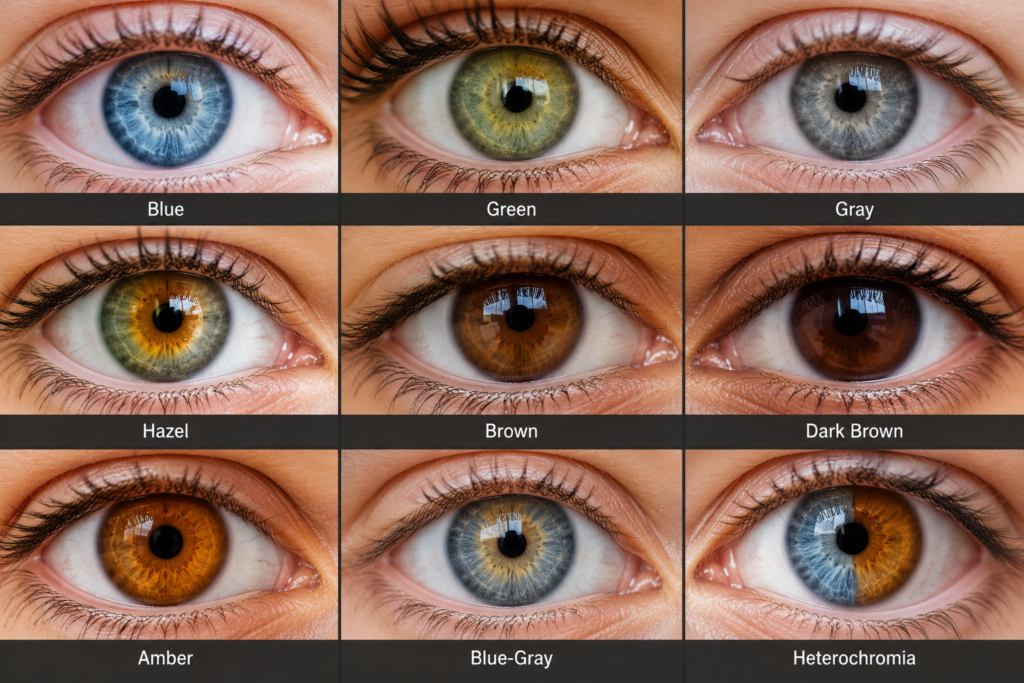
My wife and I were discussing eye colors and how some people are more sensitive to sunlight than others. I almost always wear very dark sunglasses because bright light can quickly become uncomfortable. Some people might dismiss that as a weakness, but it is actually part of how people with light-colored eyes are designed.
People with light-colored eyes, such as blue, green, gray and hazel often experience greater sensitivity to sunlight and bright artificial lighting than those with darker eyes. Ophthalmologists explain that this is because light-colored irises contain less melanin, the pigment that helps absorb incoming light. With less natural pigment, more light reaches the inside of the eye, creating increased glare and discomfort. It is not a flaw. It is simply part of how they were made.
Our physical design often illustrates spiritual truths. Just as God created people with different physical characteristics, He also created us with different emotional temperaments. Some people seem to have fewer emotional and spiritual filters, allowing them to feel the joys and burdens of life more deeply. While others may dismiss them by saying, “They’re just too sensitive,” God does not make mistakes when He knits us together in the womb.
A tender heart that is surrendered to God is not a defect. It is part of His divine design. When we strip away calloused hearts and hardened attitudes, a soft, responsive spirit becomes uniquely available to the Lord. Such a heart, when surrendered to God, can become especially responsive to the gentle promptings of the Holy Spirit and can recognize the unspoken pain of others with remarkable clarity. It notices needs that others overlook. It is moved by suffering that others pass by. It is quick to pray, quick to encourage, and quick to show compassion.
There is, however, an important distinction between having a God-given sensitive nature and becoming easily offended.
A sensitive nature turns outward. It enables a person to love deeply, to weep with those who weep, and to rejoice with those who rejoice. It makes them a powerful instrument for compassion, empathy, encouragement, and intercession.
Rejoice with them that do rejoice, and weep with them that weep. (Romans 12:15 KJV)
An easily offended spirit, on the other hand, turns sensitivity inward. It interprets every disagreement as a personal attack, every correction as rejection, and every disappointment as an injury. Rather than becoming a channel of God’s grace, it becomes consumed with self-protection, pride, or unresolved hurts.
When sensitivity is surrendered to God, it does not produce fragile emotions. Instead, it produces Christlike compassion. It enables a person to handle difficult conversations with gentleness, to choose words that heal instead of wound, and to extend grace where others might respond harshly.
Interestingly, my own hazel eyes reflect this truth in another way. Hazel eyes are unique because they contain varying amounts of pigment, often revealing different shades of green, brown, amber, and even golden flecks depending on the light around them.
In much the same way, God has not fashioned every heart with the same degree of sensitivity. Some hearts are naturally more tender than others. Some are deeply moved by the burdens of those around them, while others remain steadier in moments of crisis. Neither temperament is better than the other. Just as no two hazel eyes are exactly alike, God has uniquely fashioned each of us to serve a different purpose within His body.
Yet spiritual maturity is not simply accepting how God made us. It is allowing the Holy Spirit to govern that sensitivity. There are moments to weep with those who weep, moments to speak the truth boldly, moments to overlook an offense, and moments to lovingly confront sin.
Spiritual maturity is not becoming less sensitive. It is learning to let the Holy Spirit direct our sensitivity.
God’s kingdom has room for every temperament. Some believers are built to stand firm in the fiercest storms with remarkable steadiness. Others are designed with hearts so tender that they notice burdens everyone else overlooks. Neither is better than the other. Both are needed. The steady strengthen the weak, and the sensitive remind the strong to never lose their compassion.
I had a friend who would often apologize whenever he became emotional while talking about what God had done. Almost as if he was embarrassed by it, he would say, “I’m sorry.” Then one day something changed. He stopped in the middle of sharing, looked at everyone, and simply said, “I’m not sorry.” He had realized that a heart moved by the goodness of God was not something to apologize for. It was evidence that his heart was still tender toward the Lord.
Before dismissing someone as “too sensitive,” remember that what you see as a weakness may actually be one of the very qualities God intends to use for His glory. A heart that feels deeply, when submitted to Christ, can become one of His greatest instruments for ministering to a hurting world.
Psalm 139:14 (KJV) I will praise thee; for I am fearfully and wonderfully made: marvellous are thy works; and that my soul knoweth right well.
1 Corinthians 12:18 (KJV) But now hath God set the members every one of them in the body, as it hath pleased him.
Leave a Reply