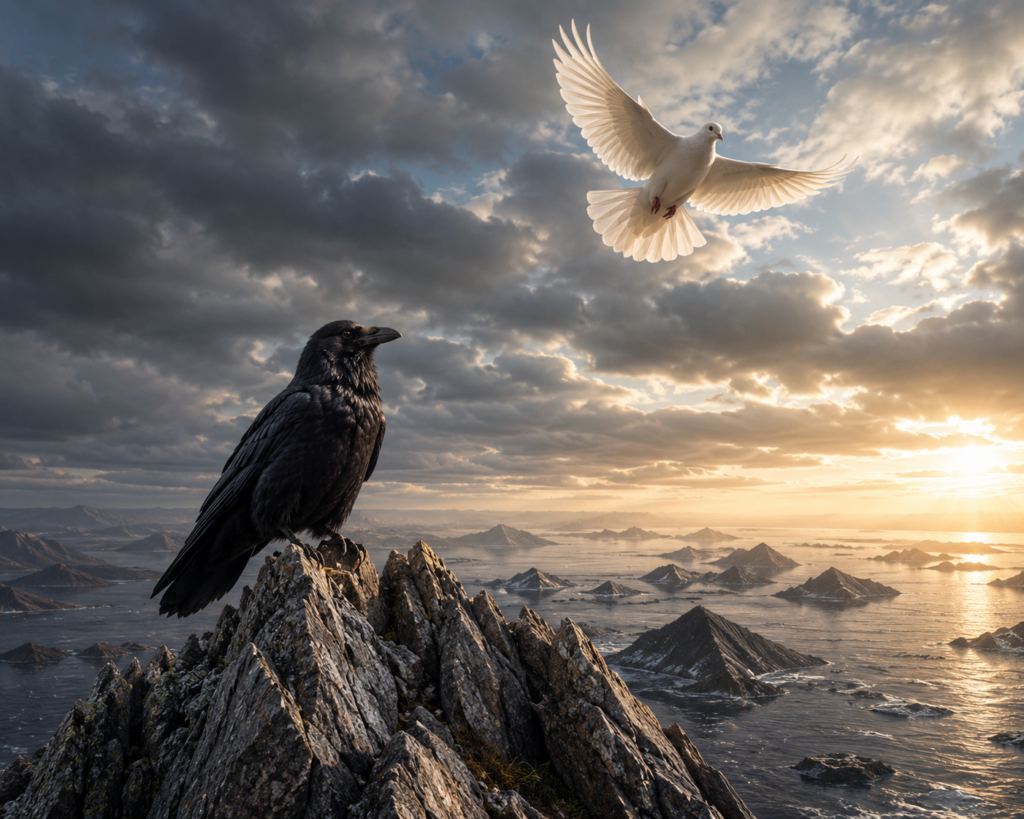
Have you ever seen a crow or a raven sitting on the blacktop feeding off of a dead carcase? What you won’t see is a dove doing this, because doves don’t feed on dead things.
I bring this up to look into an interesting detail in the story of Noah and the ark that is easy to miss if you are not paying close attention.
Genesis 8:3-12 (NKJV)
And the waters receded continually from the earth. At the end of the hundred and fifty days the waters decreased. Then the ark rested in the seventh month, the seventeenth day of the month, on the mountains of Ararat. And the waters decreased continually until the tenth month. In the tenth month, on the first day of the month, the tops of the mountains were seen. So it came to pass, at the end of forty days, that Noah opened the window of the ark which he had made. Then he sent out a raven, which kept going to and fro until the waters had dried up from the earth. He also sent out from himself a dove, to see if the waters had receded from the face of the ground. But the dove found no resting place for the sole of her foot, and she returned into the ark to him, for the waters were on the face of the whole earth. So he put out his hand and took her, and drew her into the ark to himself. And he waited yet another seven days, and again he sent the dove out from the ark. Then the dove came to him in the evening, and behold, a freshly plucked olive leaf was in her mouth; and Noah knew that the waters had receded from the earth. So he waited yet another seven days and sent out the dove, which did not return again to him anymore. (Genesis 8:3-12)
Notice something remarkable. In verse 5, the tops of the mountains became visible. That means there were now exposed places where a bird could perch. Forty days later Noah opened the window and first released a raven. Genesis tells us that it “kept going to and fro until the waters had dried up from the earth.” It is likely that the raven rested on these mountain tops. He then released a dove, but the dove found no resting place for the sole of her foot and returned to the ark.
That raises an interesting question. If the mountain tops were already visible, why did the dove return?
The answer may be found in the very different nature of these two birds.
Ravens are perfectly comfortable perching on rugged, rocky cliffs like the newly exposed peaks of Mount Ararat. They are scavengers and could have found food by feeding on the carcasses of animals floating in the waters or stranded on the rocky heights. The barren mountaintops were enough for the raven.
The dove was entirely different. Doves generally nest and forage in valleys and among trees and low-lying vegetation. They are gentle birds that feed primarily on seeds, grains, and tender plant growth. A bare, rocky mountain peak surrounded by endless water was neither a suitable home nor a place where food could be found. Although the mountain peaks had appeared, the valleys where vegetation normally grows were still underwater. So the dove returned to the ark because there was still no place where life had truly been restored.
This beautiful contrast points us toward an important spiritual lesson.
The raven represents the old man, our fallen, carnal nature. It is comfortable in a landscape of death. It feeds on gossip, bitterness, old sins, resentment, and things that are spiritually lifeless. It finds satisfaction in the wreckage and does not feel the need to return to the safety of the ark because it has learned to survive on what is dead.
The dove paints a completely different picture.
Throughout Scripture, the dove becomes associated with purity, peace, sacrifice, and ultimately the Holy Spirit. Just as the Holy Spirit descended upon Jesus in the form of a dove, this bird naturally illustrates a life led by God’s Spirit. The dove refuses to settle in a place where death still reigns. It longs for life. If there is no evidence of new growth, it returns to its place of safety.
A week later Noah sent the dove out again. This time it returned with a freshly plucked olive leaf in its mouth. The dove did not simply remain outside enjoying the new growth. It brought the evidence of life back to everyone inside the ark. It became a messenger of hope, peace, and new beginnings.
Isn’t that what spiritually mature believers should do? When God gives us fresh life, renewed hope, or a testimony of His goodness, we are not meant to keep it to ourselves. We bring that evidence back to encourage others who are still waiting for God’s promises to unfold.
Then Noah waited another seven days and released the dove once more. This time it never returned.
The earth had been restored. The dove had finally found the home it had been searching for all along.
What a beautiful picture of spiritual maturity. There comes a point when God’s work of restoration is complete, and what was once only a promise has become a reality.
The lesson leaves each of us with a simple but searching question.
Which bird are we operating like today?
Are we like the raven, content to circle over a broken world, feeding on things that are spiritually dead and finding comfort in hard places?
Or are we like the dove, refusing to settle for a dead landscape, continually seeking what brings life, and carrying hope back to others until God’s work of restoration is complete?
Ephesians 4:22-24 (KJV) That ye put off concerning the former conversation the old man, which is corrupt according to the deceitful lusts; And be renewed in the spirit of your mind; And that ye put on the new man, which after God is created in righteousness and true holiness.
Romans 8:5-6 (KJV) For they that are after the flesh do mind the things of the flesh; but they that are after the Spirit the things of the Spirit. For to be carnally minded is death; but to be spiritually minded is life and peace.
Colossians 3:1-2 (KJV) If ye then be risen with Christ, seek those things which are above, where Christ sitteth on the right hand of God. Set your affection on things above, not on things on the earth.
Leave a Reply