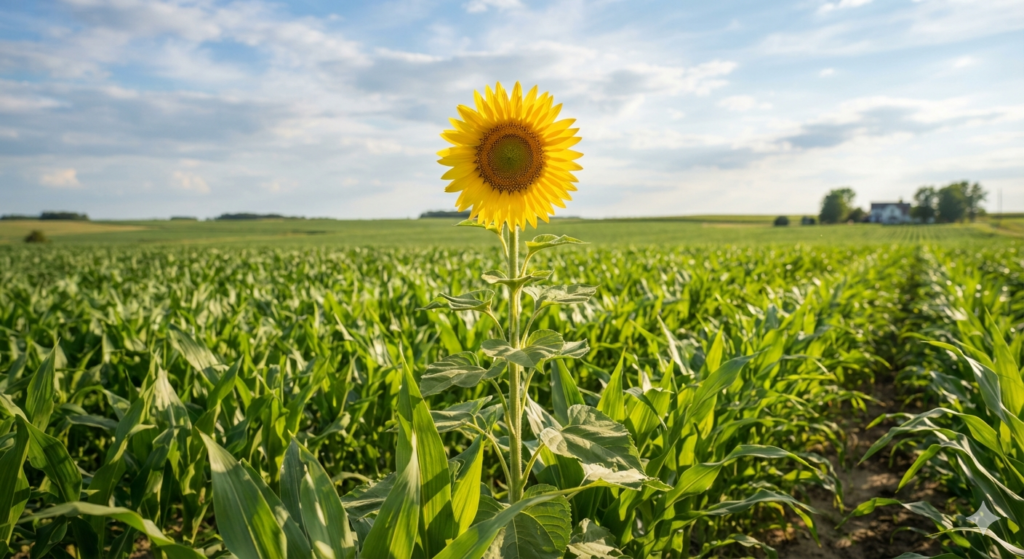
Have you ever wondered what defines a plant as a weed? What distinguishing characteristics determine which plants fit into this category. Is it their intrusive growth? Is it their size, shape or smell? What is it that sets these plants apart? Surprisingly, none of those things define a weed. The definition is fairly simple. A weed is simply any plant growing where it is not intended to be.
That seems strange to us at first maybe because there are weeds that we know are weeds. Our parents told us they were weeds. You can go to the store and buy weed killer with pictures of these on them. So they must be a weed.
Let’s look at a few weeds to gain some understanding.
Clover used to be included as a standard, highly valued ingredient in almost all commercial lawn seed mixes because it acted as a natural caretaker for the surrounding grass. Clover is a legume that pulls nitrogen from the air and converts it into a usable nutrient in the soil. This process, called nitrogen fixation, provided free, continuous fertilizer that kept the neighboring grass deep green and healthy. It grows well in compacted or poor-quality soil, breaking up tough earth with its roots and filling in bare patches before actual problematic weeds could take over.
The shift in perspective had nothing to do with the plant changing, but everything to do with chemical marketing. In the 1950s, chemical companies introduced selective broadleaf herbicides designed to kill dandelion and crabgrass. Because clover is biologically a broadleaf plant, these chemicals killed it too. To avoid consumer complaints that the chemicals were ruining the clover in their yards, chemical companies rebranded clover as an undesirable weed. Within one generation, marketing campaigns successfully convinced the public that a perfect lawn should be a uniform, monoculture stretch of pure turfgrass.
Just like clover, dandelions were intentionally brought to North America by European immigrants who prized them as a vital, multi-purpose crop. For centuries, they were celebrated as food, medicine, and indicators of spring long before they were targeted as a lawn nuisance. Every part of the dandelion is edible. The leaves pack more iron and calcium than spinach and the roasted roots serve as a caffeine-free coffee substitute. Dandelions have a massive, deep taproot that acts as a natural drill. They fracture hard, compacted clay soil, aerating the ground and pulling nutrients from deep underground up to the surface where shallow-rooted grass can reach them. They are among the earliest flowers to emerge in spring, providing a critical, life-saving source of nectar and pollen for honeybees waking up from winter.
The downfall of the dandelion as mentioned previously happened during the same mid-20th-century shift that demonized clover. When suburbs grew, people wanted perfect lawns that looked like golf courses. Because dandelions are incredibly resilient and spread their seeds via the wind, they easily breached these managed spaces. Chemical companies capitalized on this by running aggressive marketing campaigns that associated dandelions with property neglect and laziness. To sell new lawn chemicals, the industry successfully transformed a historical pantry staple into public enemy number one.
Wildflowers are the ultimate example of how context defines a weed. They are simply native plants growing naturally in their home environment, yet they are constantly targeted whenever they cross human boundaries. They evolved locally, native wildflowers require zero fertilizers, very little water, and minimal care to thrive. They are perfectly synchronized with local birds, butterflies, and bees, providing the exact food and shelter that native wildlife needs to survive. Their diverse, massive root networks prevent soil erosion, absorb heavy rainfall to prevent flooding, and naturally filter groundwater.
Wildflowers became weeds simply because they do not grow in straight, predictable lines. In a formal flower bed or a uniform grass lawn, a rogue wildflower looks messy, chaotic, and “unmanaged.” For decades, local city ordinances even made it illegal to let them grow in yards, labeling them as code violations or overgrown nuisances.
You see, we have been programmed into thinking some plants are weeds. Many of these sought after plants have been deemed weeds by those who do not see their benefit.
I repeat that a weed is simply any plant growing where it is not intended to be. A giant beautiful sunflower is just a weed in a commercial cornfield. Likewise a stalk of corn is a weed in a garden of sunflowers.
This is not to say that every plant is good. Some are poisonous. Some are invasive. Some genuinely threaten the health of everything around them. Those should be recognized for what they are. But many plants have been unfairly labeled as weeds, not because they lack value, but because their value was never understood.
Ralph Waldo Emerson once observed, “What is a weed? A plant whose virtues have not yet been discovered.” While that thought doesn’t apply to every plant, it serves as a reminder that we can easily overlook value when we judge by appearances alone.
For those that are willing to invest the time though, they reap the benefits.
Well what does that have to do with us? A lot actually.
Do you have someone in your life that seems like a weed? They just don’t fit and don’t seem to contribute anything good. Everyone else may think the same thing. Could it be that their virtues or their talents have not yet been discovered. Could it be that they have not been invested in?
Maybe you feel like a weed sometimes. One thing to remember is that you have value and talent. Maybe you don’t even know what it is at this point, but that doesn’t mean it doesn’t exist. Sometimes you feel like a weed because you’re in the wrong garden.
That doesn’t mean that if you aren’t being used in the way you think you should be, you’re automatically in the wrong garden. It may simply mean you haven’t yet grown to your full potential. Many plants harvested too early never provide all the benefit they were created to give. Just because you aren’t receiving the exposure you think you should doesn’t mean you’ve been neglected. After all, mushrooms grow in the dark. It may simply mean this is a season to put your roots down and continue growing where God has planted you.
There are times, however, when God does call someone to a different garden. That may be a new season of life, a new job, a new ministry, a new group of friends, or even another church. That doesn’t necessarily mean the garden you are leaving is bad. Sometimes God simply has another place where He intends for you to grow and bear fruit.
Even then, healthy plants are transplanted carefully. A plant ripped from the soil before the proper time, or planted where it doesn’t belong, can be damaged or even destroyed. We should be careful not to mistake impatience for God’s leading.
You see, this principle applies to many areas of our lives. But nowhere is it more important than in the kingdom of God.
When the prophet Samuel went to Jesse’s house to anoint the next king of Israel, Jesse didn’t even bother to invite his youngest son, David, to the meeting. David was left out in the fields tending the sheep because his own family didn’t see royal potential in him. Jesse looked at David and saw a shepherd boy who wasn’t even worth inviting to the gathering. God looked at the same young man and saw the future king of Israel. Human eyes looked at outward appearance and stature, but God looked at the heart and chose him.
When Zacchaeus climbed the tree, the crowd had already labeled him. They saw a corrupt tax collector who wasn’t worth God’s attention. Jesus saw a man ready for repentance. Society saw no redeeming value in him. Yet, Jesus looked past the crowds, called him by name, and chose to stay at his house. Jesus openly declared Zacchaeus’s value by calling him a “son of Abraham”, proving that no one is beyond growth and redemption.
Then there’s Jesus. When Philip found Nathaniel he said We have found him, of whom Moses in the law, and the prophets, did write, Jesus of Nazareth, the son of Joseph. And Nathanael said unto him, Can there any good thing come out of Nazareth? Philip saith unto him, Come and see (John 1:45-46).
Had we taken Jesse’s opinion, we would have bypassed David. Had we listened to the crowd, we would have passed over Zacchaeus. Had we stopped with Nathanael’s first impression, we would have rejected Jesus. Every one of them was judged by where they came from or what others saw. God judged them by what He knew they could become.
The same is true spiritually. We should not be naïve. There are influences, teachings, and people who are destructive, and Scripture warns us to recognize them. But neither should we make the opposite mistake of dismissing someone simply because they don’t fit our expectations. God often sees potential where we see inconvenience.
We must be attentive to those God places in our garden. The people others overlook may become the greatest testimony of God’s grace. The person everyone has written off may simply be growing where no one expected. Before we dismiss someone as a weed, we should remember that God has a long history of seeing value where everyone else sees none.
1 Samuel 16:7 But the LORD said unto Samuel, Look not on his countenance, or on the height of his stature… for the LORD seeth not as man seeth; for man looketh on the outward appearance, but the LORD looketh on the heart.