Barnabas is a man mentioned in the book of Acts and the subject of many lessons. One of those comes from a point in his life of great contention.
While Barnabas may not have written a New Testament book or preached on the Day of Pentecost, his fingerprints can be found on the ministries of others. His life demonstrates the power of encouragement, grace, and investing in people.
We first see Barnabas arrive early in the book of Acts.
Acts 4:36-37 NLT
36 For instance, there was Joseph, the one the apostles nicknamed Barnabas (which means “Son of Encouragement”). He was from the tribe of Levi and came from the island of Cyprus. 37 He sold a field he owned and brought the money to the apostles.
Son of Encouragement, what an amazing nickname. We see that he lived up to this throughout Acts.
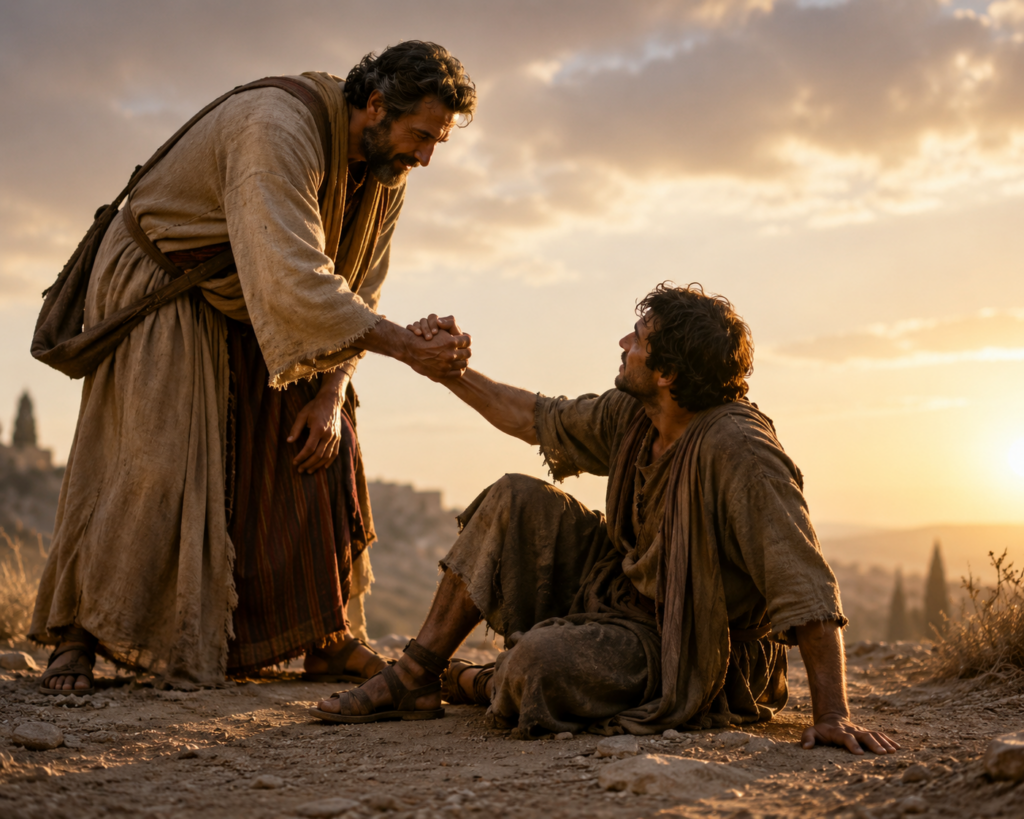
Barnabas stepped out, took Saul by the hand, and personally brought him before the Apostles. He defended Saul, testifying how Saul had boldly preached in Damascus. Without Barnabas putting his own stellar reputation on the line, Saul would have been rejected by the church leadership.
Acts 9:26-27 NLT
26 When Saul arrived in Jerusalem, he tried to meet with the believers, but they were all afraid of him. They did not believe he had truly become a believer! 27 Then Barnabas brought him to the apostles and told them how Saul had seen the Lord on the way to Damascus and how the Lord had spoken to Saul. He also told them that Saul had preached boldly in the name of Jesus in Damascus.
Later when the gospel spread to non-Jewish Greeks in Antioch, the Jerusalem church sent Barnabas to investigate. Seeing the immense potential of a multi-ethnic church, Barnabas realized he needed a specific partner who understood both Jewish law and the Gentile world. Barnabas goes and finds Saul/Paul when it seems no one else was concerned about him.
Act 11:25 KJV Then departed Barnabas to Tarsus, for to seek Saul:
Humanly speaking, Barnabas played a crucial role in preserving and advancing Saul’s ministry twice.
It makes one think who, humanly, taught Paul more about grace than Barnabas. One can’t say for sure. The son of encouragement reached for him and helped launch his ministry.
Fast forward to Acts 15:
Act 15:39 KJV And the contention was so sharp between them, that they departed asunder one from the other: and so Barnabas took Mark, and sailed unto Cyprus;
Can you imagine the impact this had on Barnabas? With all that he had invested in Paul. With every conversation they had likely had about grace. Just to see Paul given the opportunity to extend a second chance, to extend grace, not to a stranger but to Barnabas’s own family member, and refuse it.
Though the Bible doesn’t specify, one has to wonder if Barnabas thought as Paul would write have I bestowed upon you labour in vain (Galatians 4:11). The heartbreak he likely endured was probably tremendous.
Barnabas learned something that many of us eventually discover: grace is not always easy. Grace can be costly.
If you’re unsure about that, look at Jesus. Grace and redemption carried Him to a cross.
When people fail, grace extends a hand, not a whip. It seeks restoration more than punishment and redemption more than rejection. The only time we should look down on someone is when we are helping them up. Barnabas chose to be that person for John Mark.
Barnabas didn’t just preach that principle; he lived it.
What did the Son of Encouragement do? He sailed to Cyprus. Why? Ministry. He simply continued doing what he had always done: pouring into people and preaching the gospel. He invested in Mark just like he invested in others. Who knows if it wasn’t Barnabas investment in John Mark that kept him, that encouraged him, that left the door open that God would lead John Mark to write the gospel of Mark.
Barnabas understood a principle that Solomon would later record:
In the morning sow thy seed, and in the evening withhold not thine hand: for thou knowest not whether shall prosper, either this or that, or whether they both shall be alike good. (Ecclesiastes 11:6 KJV)
Barnabas kept sowing into people. He invested in Saul. He invested in Mark. He likely invested in countless others whose names are lost to history. He could not know which seeds would bear the greatest fruit, so he simply kept planting.
It is noteworthy that according to historical timelines Barnabas was likely alive when Paul and Mark were restored. Oh what joy this would have brought Barnabas.
Another important observation is what some have observed in Pauls’ writing style around this time. The painful split over John Mark seems to have profoundly shaped Paul. In his earliest letters, written around the time of the split, Paul’s tone could be intensely rigid regarding standards of apostolic work. However, his later letters reveal a deeply matured view of human weakness and second chances; a view that sounds remarkably like Barnabas.
During the argument in Antioch, Paul looked at Mark’s failure, while Barnabas looked at Mark’s potential. To Paul, Mark had deserted them, so he was a liability. Yet look at how Paul’s theology of restoration softened over the years.
In Colossians 3:13 Paul instructs the church to bear with one another and forgive one another… just as the Lord forgave you.
In Galatians 6:1, Paul explicitly instructs leaders: If someone is caught in a sin, you who are live by the Spirit should restore that person gently. The Greek word for restore used here is katartizo, meaning to mend a broken bone or repair a torn fishing net. It is exactly what Barnabas did for Mark.
Whether this experience contributed to it or not, Paul’s later writings reveal a man who had come to appreciate restoration in a deeper way. Perhaps he learned what all of us eventually must: you learn a great deal about grace when you receive it. You learn something else when you extend it.
Grace received humbles us. Grace extended stretches us. Both change us.
The most beautiful evidence of Paul’s growth is that he eventually adopted Barnabas’s vocabulary. In his later letters, Paul repeatedly urges believers to practice parakaleo; the very Greek root from which Barnabas received his name, “Son of Encouragement.”
Perhaps Paul came to realize that the church cannot survive on mission, doctrine, and strategy alone. It must also be sustained by the costly, fiercely loyal grace modeled by the man who first went to Tarsus to find him.
What is the takeaway?
If you’re a Paul and you tend to see things in a stricter fashion, pray that God would help you see through the lens of grace. Before focusing on another person’s failures or shortcomings, before wondering why they can’t seem to move past a mistake or overcome a hurdle, ask Him to examine your own heart.
Search me, O God, and know my heart: try me, and know my thoughts: And see if there be any wicked way in me, and lead me in the way everlasting (Psalm 139:23-24 KJV).
If you are a John Mark and you have failed and someone hasn’t extended that grace to you, know that God has plenty of grace. Do not let another person’s opinion become the final word on your future. Remember that a just man falleth seven times, and riseth up again (Proverbs 24:16 KJV).
If you are an encourager, I cannot promise that you won’t get tired. I cannot promise that your heart will not be broken by the people you invest in. Barnabas certainly experienced that pain. What I can tell you is this: don’t stop investing in people.
Barnabas kept pouring into lives when others walked away. He kept believing in people when others doubted them. He kept encouraging when encouragement cost him something.
Who knows what lasting impact your investment may have? Who knows if the person you encourage today may someday strengthen countless others? And who knows if the heartbreak you endure now may become the soil from which something beautiful grows?
1 Thessalonians 5:11 (KJV) Therefore encourage one another and build each other up, just as in fact you are doing.